



Parenting from Your Heart
Introduction
How can we deal with our two-year-old when she grabs her friend's toys? What might we say to a four-year-old who refuses to let other children slide on the playground? How can we talk with a teenager about the chores he has left undone - again? How do we protect our children when their choices endanger their safety? What resources will help us work with our own anger, frustration, or pain when communication with our children seems strained or non-existent?
As parents, we are constantly faced with situations like these. Multiply the children and the challenges mount. Add the pressures of work (or unemployment), money (or lack thereof), time, relationships, and other commitments, and the pot threatens to boil over. Then, for some, there are the stresses of raising children alone, without a partner, extended family, or community. And there are myriad additional challenges many parents face. It is no wonder parents yearn for support, guidance, and relief. Yet when we turn to parenting books or experts, the advice we find is often contradictory and may not align with our own values and hopes for our children and families. Even when we do find an idea we want to try, changing habits and patterns in relationships can be enormously challenging in itself.
In this booklet, I present to parents and others who are connected with children a brief introduction to how Nonviolent Communication (NVC) may support their parenting in practical, immediate ways. I particularly hope to address parents' yearning for deeper connection with themselves, their partners, and their children, and their desire to contribute, through parenting, to fostering peace in the world. The approach I describe, as you will see, goes beyond immediate solutions and into the realm of personal and social transformation.
This booklet explores a variety of topics and situations and offers ten exercises to help you put into practice what you are learning as you shift or adapt your parenting approaches. However, it is by no means a comprehensive exploration of NVC and parenting. I have not touched upon many topics that have come up in my workshops and classes, on the NVC-parenting email list, and in my own life. I hope, nonetheless, that what I have covered here will be practical enough to offer you some concrete tools for deepening connection with your children, and exciting enough to encourage you to consider learning even more. If you choose to put these ideas into practice and they make a difference in your family life, I would love to hear from you.
For a review of the basic steps of NVC and additional information on NVC, see the back of the booklet.
"Power-over" versus "Power-with"
When parents want children to do something their children don't want to do, it's often tempting to force the children's compliance by using the enormous physical, emotional, and practical power adults have over them (by practical, I mean that adults have much greater access to society's resources and control over the course of their own - and their children's - lives). Yet I am convinced that attempting to coerce a child to do something she or he doesn't want to do neither works effectively in the short term nor supports families' long-term needs. (The only exception comes when there is threat to health or safety, in which case NVC suggests that we use non-punitive, protective force.) In NVC, we refer to using power to enforce what we want as "power-over," in contrast with using power to meet everyone needs, which we refer to as "power-with."
Maria, a parent who had read some of my articles, asked me a question that points directly to the temptation to use the control we have over resources to influence a child's behavior (note that all people's names have been changed):
"I've been 'bargaining' with my two-year-old son Noel using rewards and consequences, and sometimes it seems to me that it's quite effective. At least, it gets him to do what I want, such as eat the food on his plate. Yet I'm somehow uncomfortable with this. Is there a problem with rewards and consequences if they work?"
I do think that there is a problem with rewards and consequences, because in the long run, they rarely work in the ways we hope. In fact, I think that they are likely to backfire. Marshall Rosenberg explores this point by asking parents two questions: "What do you want your child to do?" and "What do you want your child's reasons to be for doing so?" Parents rarely want their children to do something out of fear of consequences, guilt, shame, obligation, or even a desire for reward.
In this context, when I hear parents - or parenting experts - say that consequences are effective, I often wonder what they mean. I believe "effective" usually means that parents get compliance from children - that children do what parents tell them to do - at least for a while. Both the goal (compliance) and the means (rewards and consequences) come at a price. They not only involve fear, guilt, shame, obligation, or desire for reward, they are also often accompanied by anger or resentment. And because rewards and consequences are extrinsic motivations, children become dependent on them and lose touch with their intrinsic motivation to meet their own and others' needs.
I believe that the most powerful and joyful intrinsic motivation human beings have for taking any action is the desire to meet our own and others' needs. Both children and adults act out of this intrinsic motivation when they feel genuinely connected to themselves and each other, when they trust that their needs matter to the other, and when they experience the freedom to choose to contribute to the other.
If we want our children to experience intrinsic motivation for doing what we ask them to do, we can shift our focus away from authority and imposed discipline and toward paying as much attention as possible to everyone's long-term needs. This may take more time in the moment because it means going beyond the present problem and remembering what matters most in the big picture. Yet the time is worth the investment. In the long run, families can experience deeper connection, trust, and harmony, and children can learn powerful life skills. I believe that most parents find these goals much more appealing and exciting than mere compliance.
Instead of rewards and consequences, NVC offers three starting places for connecting with others: offering empathy, expressing one's own observations, feelings, needs and requests, and connecting with oneself through self-empathy. In the next three sections, I will explore each of these options in relation to the question Maria asked me.
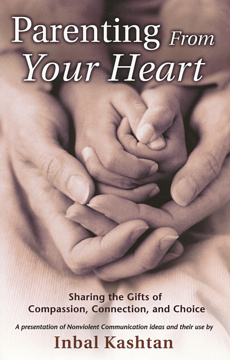 This
article appears as the first chapter of the booklet Parenting
from Your Heart: Sharing the Gifts of Compassion, Connection, and Choice by Inbal Kashtan, published
by Puddle Dancer Press.
This
article appears as the first chapter of the booklet Parenting
from Your Heart: Sharing the Gifts of Compassion, Connection, and Choice by Inbal Kashtan, published
by Puddle Dancer Press.
Inbal's audiobook, "Connected Parenting: Nonviolent Communication in Family Life" is available from Bay Area Nonviolent Communication.
For more information, see Marshall Rosenberg's Articles and the Center for Nonviolent Communication.
Reprinted with permission of the author. Copyright © 2003 Inbal Kashtan.