




Does the Santa Legend Endanger Trust?
Children love Santa Claus, and it's not just about the presents. It's about fantasy, hope, and fun. But there's no getting around it: the Santa Claus legend has created a dilemma for parents. Is it ethical to tell a child that Santa Claus is real? Is this a harmless "white lie", an innocent and loving attempt to give a child the pleasure of make-believe and the reassurance of fitting into our culture, or is it essentially and inescapably a lie that can affect the child's critical capacity to trust?
Although my son was taught to believe in Santa, I worried about the eventual outcome this might have, as I had not been told the Santa story in my own childhood. When he asked the "Santa question" at age eight, I learned that my fears had been well-founded. I can still remember his look of dismay, confusion, and sadness as I admitted as gently as I could that Santa was, in fact, a myth. Although I then told him the true story of Saint Nicholas of Patara, this did little to comfort him. I've regretted our original decision ever since.
But how can a parent draw the line between innocent fantasy - so important in a child's life - and an ultimately harmful lie that will inevitably have to be explained later? Children thrive on fantasy and make-believe. They love inventive stories and fictional characters, and readily give their stuffed animals and dolls names and unique personalities. Fantasy and play are essential elements in a child's life. They not only bring joy and humor, but also enhance the ability to imagine and to think "outside the box". Imagination is a critical part of thinking and problem solving. What is the difference, then, between healthy fantasy and deception that endangers parent-child trust? Is there a way to keep the fantasy without the lie?
I found this puzzle to be surprisingly difficult to resolve. But after much thought I felt that there might be a middle ground. If a child were simply told the "Santa story" about a kindly old gentleman who leaves gifts for children in his make-believe world, but who remains within the fictional world of the story, there would be no need to undo the lie that he is leaving gifts for the child in our world. Parents and children could play the "Santa game" by leaving gifts for each other, just as Santa does in the story. This allows the opportunity for children to learn the pleasure of giving to their parents and siblings, as well as gaining the knowledge and appreciation of their parents' efforts on their behalf - an opportunity that is completely missed in the traditional approach.
For the Santa question, and for other stories about such figures as fairies and elves, the central question becomes: Are the characters left in their own imaginary world, or are they claimed to be somehow magically making the transition from their world to ours? Are they presented as fictional characters, meant to entertain or inspire, or can they directly affect the child in some way in the real world - leaving gifts or Easter eggs, or exchanging teeth for coins? The movie "The Purple Rose of Cairo" is a good illustration of a fictional character magically leaving his world and breaking into the heroine's real world. But the movie was presented as an intriguing and entertaining fiction, not as a news story.
If fictional characters are all left within their own make-believe worlds, parents and children could still leave surprises under the tree "like Santa does in the Santa story", thus giving the child an opportunity to give as well as receive. The child would still know the whimsy and joy of the Santa tale, but there would be no deception to explain or regret later, and the child is being given authentic information about the real world. Children need a truthful picture of their world so that they can learn to navigate within it with confidence, knowledge and safety. Providing such an understanding is as important a reason to avoid the Santa myth as the need to maintain the child's trust. If we keep the magic fantasy, but hold it within the borders of the world of fiction and storytelling, we can foster imagination and delight today without worrying about the questions we will surely be asked tomorrow.
Jan Hunt, M.Sc., offers counseling worldwide, with a focus on parenting and unschooling. She is the Director of The Natural Child Project and author of The Natural Child: Parenting from the Heart and A Gift for Baby.
If you enjoyed this article, you might like:
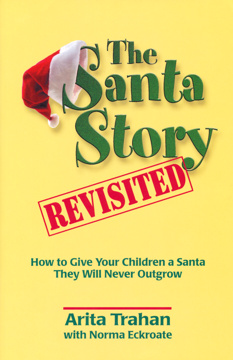
The Santa Story Revisited:
How to Give Your Children a Santa They Will Never Outgrow